AI for M&A lawyers, with every deal document on your own premises
A deal leaks once, and the price, the timetable or the deal itself can be gone. Sūveryn gives your M&A team AI for due diligence, contract review and drafting that runs on servers you own. The data room, the drafts and the questions your team asks are processed inside your perimeter.
Example with fictional case files · click to enlarge
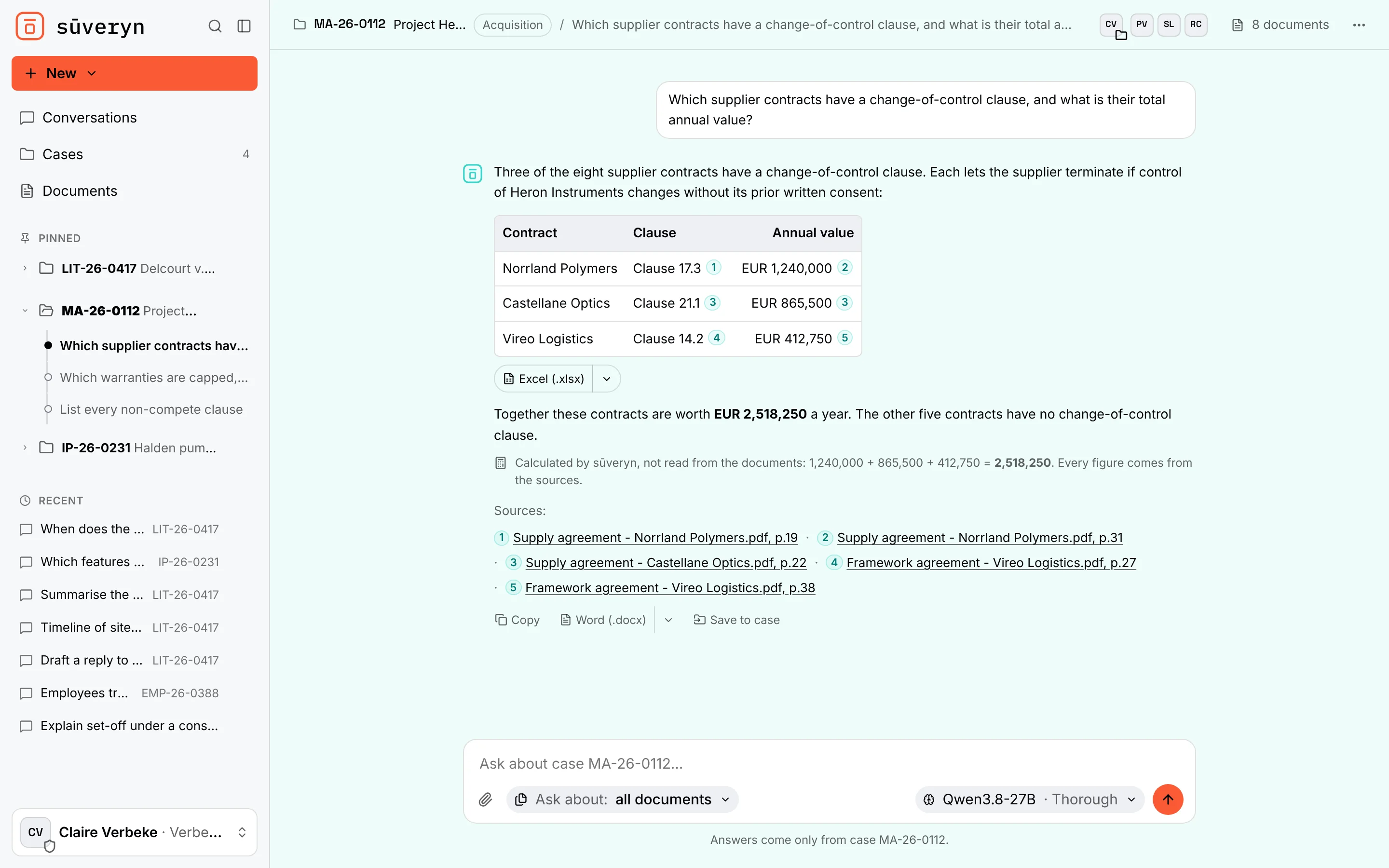
Due diligence answers with page citations, without the data leaving the firm
Ask the questions a due diligence turns on, such as change of control, exclusivity, termination and liability caps, across many contracts at once. Sūveryn answers from the documents on your own hardware and links every finding to the page it came from. Totals are calculated by the server, not guessed by the model, and any figure that isn’t in the documents is flagged. Nothing is uploaded to a shared cloud or a model vendor.
Inside information stays inside
On a listed target, what your team knows before announcement is inside information. Firms acting for an issuer may have to keep an insider list of everyone with access, with the exact date and time. Sending the same documents to an outside AI service adds a party you have to account for. With sūveryn on your own premises there is no such party: the AI runs within the firm, under your own access controls. A partner that runs the machine for you counts like any IT provider with access.
Control by architecture, not by contract
Many “legal AI” products are wrappers: a branded interface that sends your prompts and files to another company’s model, often in another jurisdiction. Their answer to confidentiality is a contract: an EU region, a no-training clause, a retention limit. As the CCBE puts it, “the less we control the stack, the more we must ensure the control by contractual obligations to the provider and rely on promises from a vendor.” Sūveryn takes the other route. The model runs on your own server, so there is no AI provider to negotiate with, and you can show it: switch it to air-gapped mode and it keeps working.
A typical AI wrapper
Sūveryn
Where the model runs
On the model provider’s servers
On your server, on your premises
Who receives your documents
The tool vendor and the model provider
No one outside the firm
What protects your data
Contract clauses: region, retention, no training
Architecture: processed on your own server, air-gapped if you choose
Can you check what it does
Closed code
Open-source code and published limitations
Works without an internet connection
No
Yes
If the vendor changes terms or stops
The service changes or stops
Code (AGPL) and models (Apache 2.0) stay with you
Answers checked against the sources
Depends on the product
Each citation checked against its passage; sums calculated by the server
What M&A teams use it for
Due diligence questions across many contracts at once, with page citations
Figures you can trust: sums calculated by the server, unsupported figures flagged
Draft memos and first versions of clauses, exported to Word; tables to Excel
Summaries of management presentations and expert reports (very long files in their best-matching parts for now)
Each deal’s documents kept together in its own case
Answers to the client’s questions, sourced from the deal documents
Answers you can check, not just trust
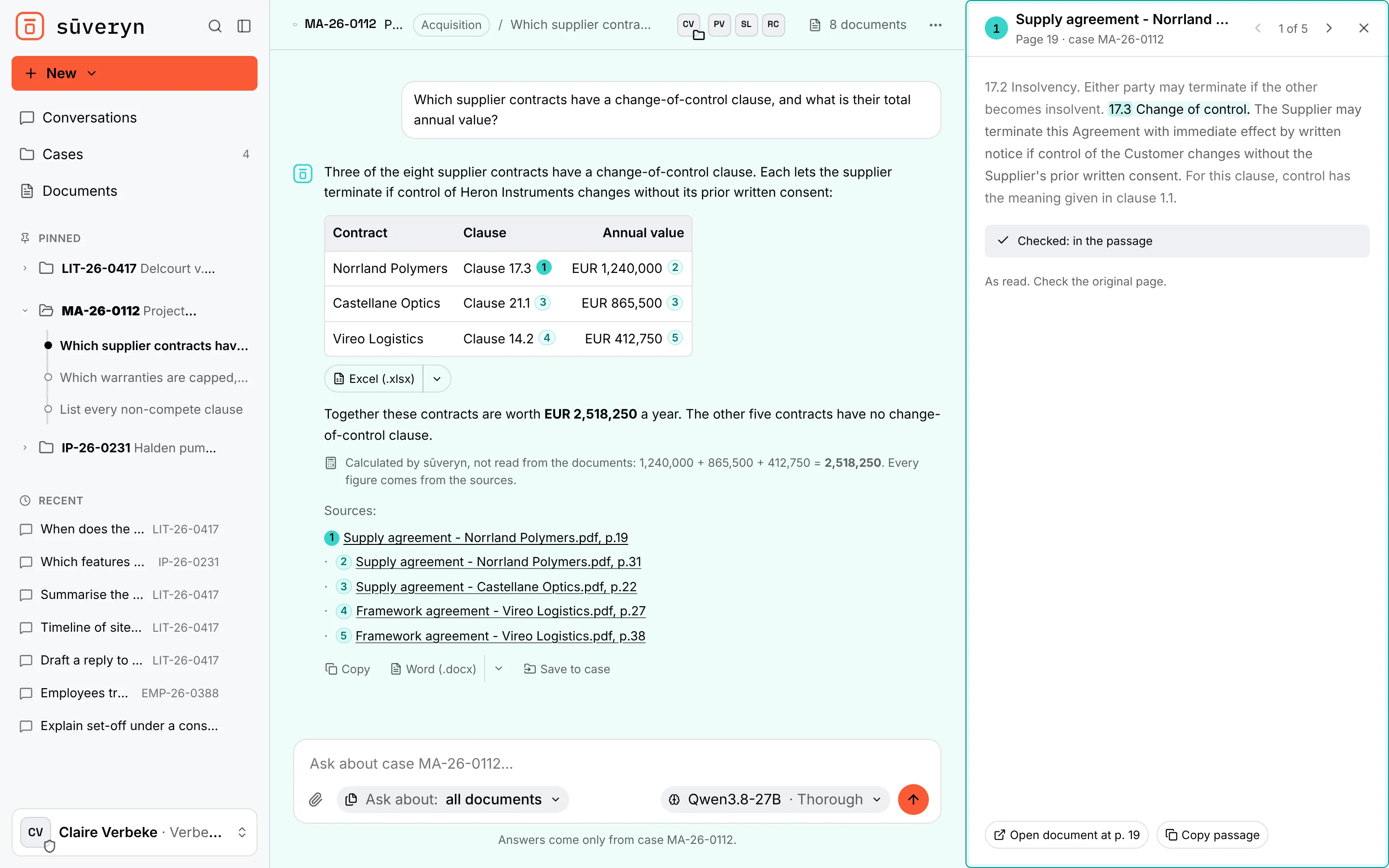
A lawyer can’t use an answer they can’t trace. Every sūveryn answer cites the passages it rests on, with the page, and opens each one with the sentence marked. Each citation is checked against its own passage: a figure, date or name that isn’t there is flagged. Sums are calculated by the server, not by the model. The bars expect lawyers to verify AI output before relying on it; a page citation turns that from an afternoon’s work into a minute’s. And text inside a document is never treated as an instruction, so a planted line in a document from the other side can’t steer the answer.
Example with fictional case files · click to enlarge
The bars set conditions; they don’t prescribe a product. The Belgian guidelines on AI for lawyers (OVB and AVOCATS.BE, January 2025) allow information covered by professional secrecy in an AI tool only when the lawyer is absolutely sure it is used “in a closed environment with sufficient safeguards”, for example within the perimeter of the own office without sharing information with the outside world (our translation). The CCBE’s technical guide on the use of AI tools and models by lawyers (27 March 2026) describes several ways to deploy AI and calls on-premise deployment “the most secure option regarding the respect for confidentiality”: the data “remains within the control of the lawyer. There is no transfer of data to a third person.” With a vendor-hosted service, it warns, “the data leaves user’s environment which, in case of lawyers, can raise confidentiality issues.” The professional duties behind this are in its guide on the use of generative AI by lawyers (2 October 2025). Sūveryn is built for the closed route: the model and your files stay on your own server, under your own access controls, with no AI provider that receives or keeps them.
For the managing partner: one less party in every deal
Whether your teams advise buyers, sellers, sponsors or lenders, the rule is the same: the fewer outside parties see the deal, the better. Every outside service that touches a deal is one more party to vet, contract with and answer for. Sūveryn adds none: the AI sits on your own server, under your own rules. Your deal teams get AI support, and you keep a simple answer for clients who ask where their information goes.
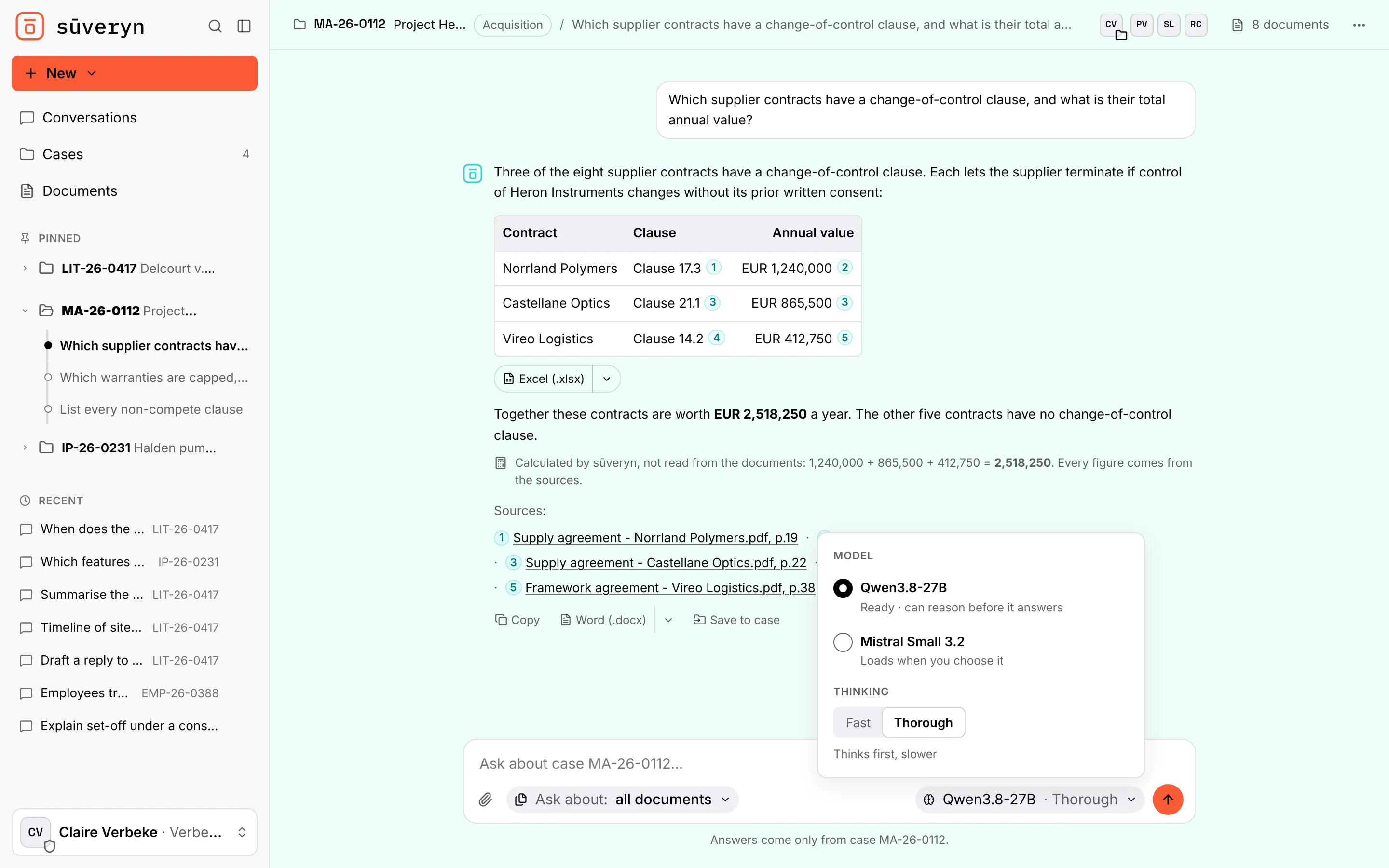
Sūveryn ships with two open-weight models, Qwen3.8-27B and Mistral Small 3.2, and your people choose the model per conversation. No model vendor sees your work. It runs on one server with a 24 GB NVIDIA GPU (RTX 4090 class).
Example with fictional case files · click to enlarge
One server in your office or server room: a 24 GB NVIDIA GPU (RTX 4090 class; a workstation card for 24/7 use), 8 cores, 64 GB RAM, 2 TB NVMe. Sized for up to 10 users, 4 asking at the same moment.
Delivered as an appliance: the operating system, PostgreSQL, the Keycloak sign-in and the model server, configured together.
Two network modes, enforced by the appliance itself: connected to approved destinations only, or fully air-gapped.
Models arrive as signed bundles that the appliance checks before installing.
Open-source code (AGPL) and a published architecture document, known limitations included, so your team can review what it does.
Your IT partner can also run it for you: the same appliance on a machine dedicated to your office, in a data centre in the EU, under your own contract with that partner. It is not a shared cloud, and Sūveryn Labs has no access to it. There it needs a data-centre GPU, which can also serve more people. Contact us before planning that.
Radical openness in service of confidentiality
The code behind sūveryn is open source, so anyone can inspect it: your IT team, an outside security firm, a sceptical partner. That is the point. A tool that holds privileged files shouldn’t ask for blind trust. The code is public; your data never is. Read the Sūveryn Manifesto for why we build this way.
Frequently asked questions
Can we use AI on a data room without breaching the NDA?
Many NDAs limit who may see the information. Because sūveryn runs inside the firm, no outside AI provider receives it. Check each NDA’s own terms.
What is an AI wrapper, and why does it matter?
A wrapper is a tool built on another company’s AI model through its API. Your documents go to the tool vendor and on to the model provider. Sūveryn has no such chain.
Does using sūveryn affect our insider list?
On your own premises the AI adds no outside party with access. If an IT partner runs the machine for you, treat that partner as you would any IT provider with access to deal files. Who on your team has access still needs to be recorded as usual.
Which models does it run?
It ships with two open-weight models, Qwen3.8-27B and Mistral Small 3.2, running on your own hardware.
When is it available?
Sūveryn is in development. You can request a pilot today: we reply within two working days with what it involves and when it can start.
See it work on a file you know by heart
A pilot runs on a closed matter, on a server in your own office. You judge the answers yourself.