sūveryn › Notaries

Your data. Your premises. Your AI.

AI for notaries that runs in your own office

Clients bring a notary what they trust to no one else: identity details, family situations, wealth, the price of a home. Sūveryn gives your office AI that reads, checks and drafts from those documents on a server you own, in your own office. Nothing goes to a shared cloud, a model vendor or an AI start-up in between.

We reply within two working days.

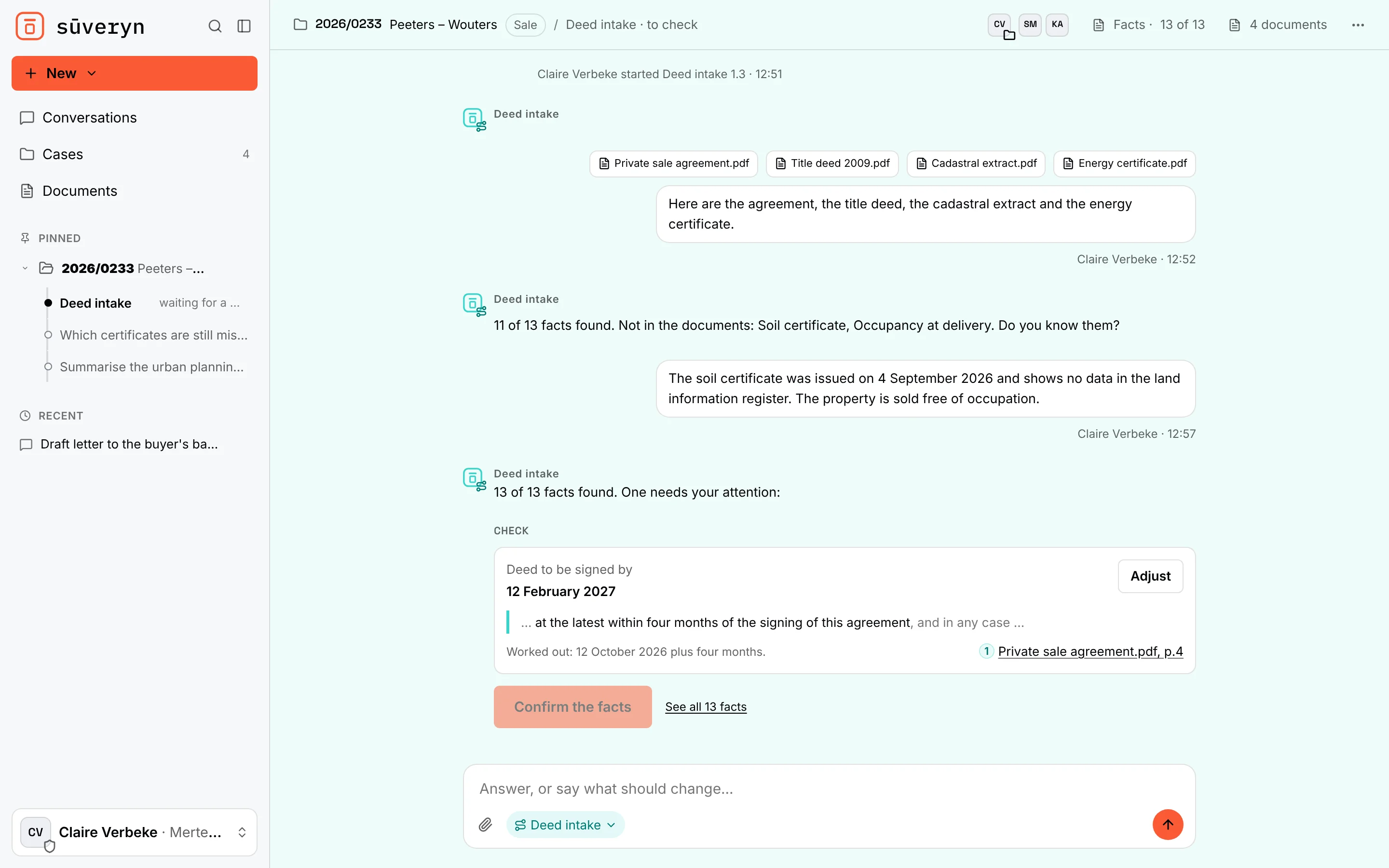
Deed intake for a sale as a conversation: the documents handed over, eleven facts read from them, two answered by the office, and the checkpoint where the facts are confirmed.
Example with fictional case files · click to enlarge

A deed intake, start to finish

Under a minute, without sound: one run of the Deed intake playbook on a fictional sale file, from the documents to the summary in the case.

Example with a fictional file · no sound, captions in the film

Your clients’ files stay on your own server

Most cloud-based AI tools send your documents to someone else’s servers. With sūveryn, the model, the documents and every question your team asks stay on hardware you control. It works fully offline and even air-gapped, so a deed, an estate inventory or a marriage contract never touches the internet. Your office keeps data sovereignty in its own hands. Sovereign here means a machine you control: in your office, or dedicated to you at a partner you choose. Never a shared cloud service, not even a European one.

Deed intake: thirteen facts, each with its source

Open a sale case, add the private agreement, the title deed and the certificates, and sūveryn reads the thirteen facts the deed needs: parties, property, cadastral data, price, guarantee, dates, suspensive conditions, title, energy certificate, soil certificate and occupancy. Each fact sits next to the passage it was read from, and a figure, date or name that isn’t in that passage is flagged. Nothing is final until someone in your office has checked and confirmed every fact. The confirmed summary is stored in the case and can be downloaded as a Word file.
Control by architecture, not by contract

Many “legal AI” products are wrappers: a branded interface that sends your prompts and files to another company’s model, often in another jurisdiction. Their answer to confidentiality is a contract: an EU region, a no-training clause, a retention limit. As the CCBE puts it, “the less we control the stack, the more we must ensure the control by contractual obligations to the provider and rely on promises from a vendor.” Sūveryn takes the other route. The model runs on your own server, so there is no AI provider to negotiate with, and you can show it: switch it to air-gapped mode and it keeps working.

A typical AI wrapperSūveryn
Where the model runsOn the model provider’s serversOn your server, on your premises
Who receives your documentsThe tool vendor and the model providerNo one outside the office
What protects your dataContract clauses: region, retention, no trainingArchitecture: processed on your own server, air-gapped if you choose
Can you check what it doesClosed codeOpen-source code and published limitations
Works without an internet connectionNoYes
If the vendor changes terms or stopsThe service changes or stopsCode (AGPL) and models (Apache 2.0) stay with you
Answers checked against the sourcesDepends on the productEach citation checked against its passage; sums calculated by the server

What notary offices use it for

Answers you can check, not just trust

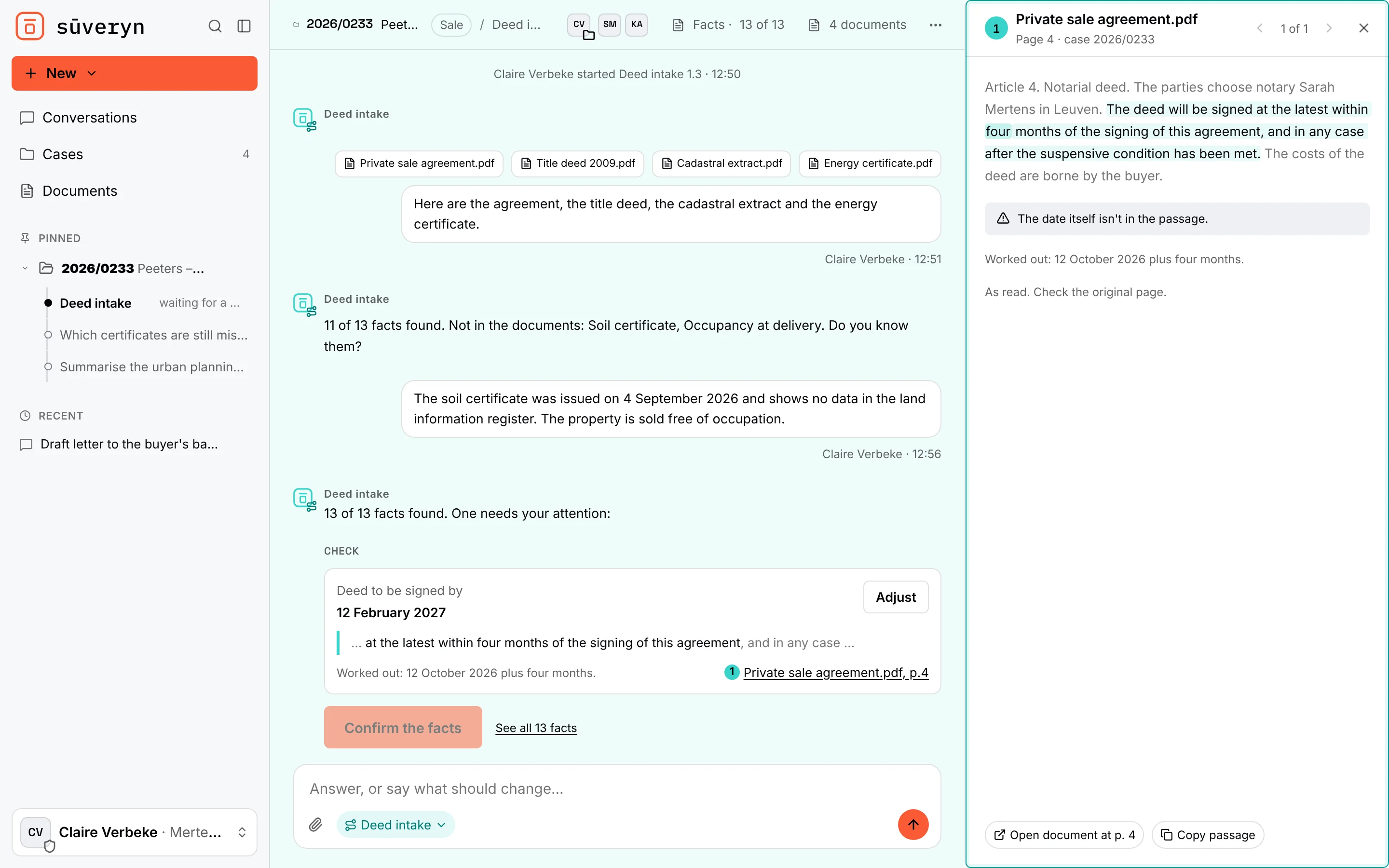
A notary can’t sign off on a fact they can’t trace. Every sūveryn answer and every fact cites the passage it rests on, with the page, and opens it with the sentence marked. Each citation is checked against its own passage: a figure, date or name that isn’t there is flagged, like the deed date in the example below, which the agreement only gives as “four months after signing”. Sums are calculated by the server, not by the model. And text inside a document is never treated as an instruction, so a planted line in a document can’t steer the answer.

The deed deadline opened at its source: the agreement gives a term, not a date, so sūveryn worked the date out and flags it for a check.
Example with fictional case files · click to enlarge

Tested on real contracts and deeds: see the benchmark.

What professional secrecy asks

Client data in a notary office is covered by professional secrecy, and the notariat’s own GDPR code of conduct was approved by the Data Protection Authority on 8 April 2021. Every cloud AI tool adds a party that receives those files: the tool vendor, and often a model provider behind it, each with its own terms on storage and retention. For lawyers, the CCBE’s technical guide on AI tools (27 March 2026) describes several ways to deploy AI and calls on-premise deployment “the most secure option regarding the respect for confidentiality”. With sūveryn the model and the files stay on your own server, under your own access controls, so no AI provider receives them.

For the notary: control you can explain to clients

Clients give a notary their most personal information because they trust it stays in the office. With sūveryn you can tell them in one sentence where it goes: nowhere, it stays on our own server. You decide who uses it and on which files, each case keeps a log of who did what, and you start with a pilot on closed files before anyone relies on it.

For IT: what runs where

Sūveryn ships with two open-weight models, Qwen3.8-27B and Mistral Small 3.2, and your people choose the model per conversation. No model vendor sees your work. It runs on one server with a 24 GB NVIDIA GPU (RTX 4090 class).

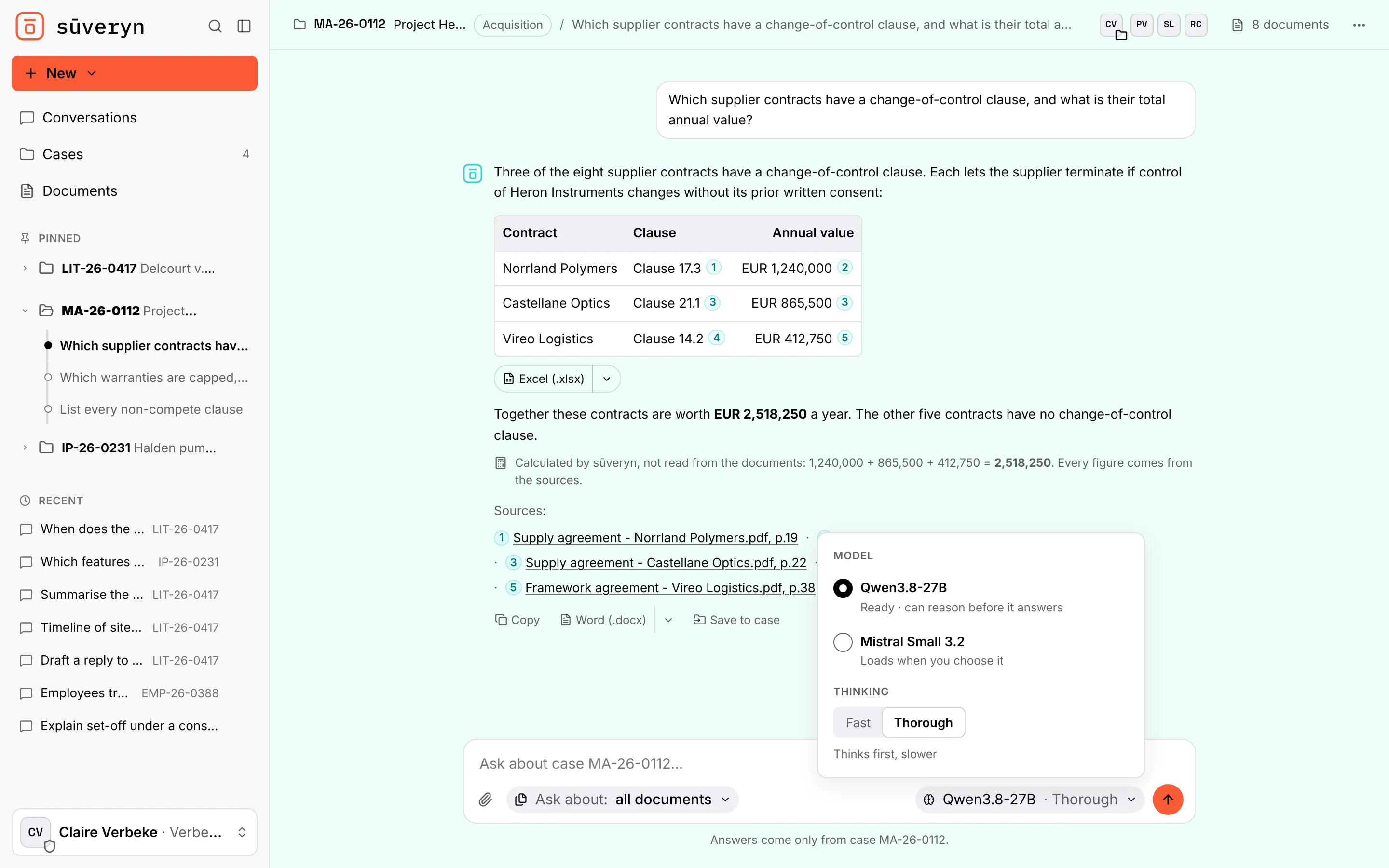
The model menu: the two open-weight models on the firm’s own server, and the choice between fast and thorough answers.
Example with fictional case files · click to enlarge

Your IT partner can also run it for you: the same appliance on a machine dedicated to your office, in a data centre in the EU, under your own contract with that partner. It is not a shared cloud, and Sūveryn Labs has no access to it. There it needs a data-centre GPU, which can also serve more people. Contact us before planning that.

Radical openness in service of confidenti­ality

The code behind sūveryn is open source, so anyone can inspect it: your IT team, an outside security firm, a sceptical partner. That is the point. A tool that holds clients’ files shouldn’t ask for blind trust. The code is public; your data never is. Read the Sūveryn Manifesto for why we build this way.

Frequently asked questions

Is ChatGPT safe for client files?

Public AI services process your prompts on the provider’s servers, and terms on retention and training vary. For files under professional secrecy, that is hard to justify to clients. With sūveryn, the model and your files stay on your own hardware.

Does sūveryn need an internet connection?

No. It runs fully offline and supports air-gapped networks, and new models arrive as signed bundles you can install without a connection.

Does it write the deed?

No. Deed intake reads and checks the facts the deed needs and gives you a summary confirmed by a person, as a Word file. Drafting from your office’s own deed templates is not available yet.

Which files can we use it for?

Any file whose documents you can upload: a sale, an estate, a gift, a company formation, a marriage contract. Deed intake, the first playbook, is for sales; there are also playbooks for company formation and care mandates.

Is a model on our own server as good as the big cloud models?

Not at everything: the largest cloud models are stronger at open-ended reasoning. For your own files, what counts is that each fact and answer rests on the documents and can be checked. Sūveryn cites the page, checks every citation and flags what it can’t trace. We tested it on real Belgian notarial deeds and publish the results, limitations included.

When is it available?

Sūveryn is in development. You can request a pilot today: we reply within two working days with what it involves and when it can start.

See it work on a file you know by heart

A pilot runs on closed files, on a server in your own office. You judge the answers yourself.

We reply within two working days.

Sūveryn for other practices